

Do stainless steel vacuum coffee mugs have a good heat - retention in cold weather?
As a supplier of stainless steel vacuum coffee mugs, I've often been asked whether our products can maintain heat effectively in cold weather. This is a crucial question for consumers, especially those who enjoy a warm beverage on a frigid morning commute or during outdoor winter activities. In this blog, I'll delve into the science behind heat retention in stainless steel vacuum coffee mugs and explain how they perform in cold conditions.
The Science of Heat Retention
To understand how well stainless steel vacuum coffee mugs retain heat, we first need to grasp the basic principles of heat transfer. There are three main ways heat can move from one place to another: conduction, convection, and radiation.
Conduction is the transfer of heat through direct contact between materials. For example, when you hold a hot cup, heat is conducted from the cup to your hand. Convection involves the movement of heat through a fluid, such as air or water. When hot air rises and cold air sinks, it creates a convection current. Radiation is the emission of heat in the form of electromagnetic waves.
Stainless steel vacuum coffee mugs are designed to minimize all three types of heat transfer. The double - walled construction of these mugs plays a key role. The inner and outer walls are made of stainless steel, which is a relatively poor conductor of heat. This reduces heat conduction from the hot liquid inside the mug to the outside environment.
The space between the two walls is evacuated to create a vacuum. Since a vacuum contains no air or other matter, it eliminates convection currents, which are a major cause of heat loss. Additionally, the inner wall of the mug is often coated with a reflective material to reduce heat loss through radiation.
Performance in Cold Weather
In cold weather, the ability of a stainless steel vacuum coffee mug to retain heat is put to the test. The extreme temperature difference between the hot beverage inside the mug and the cold outside environment creates a strong driving force for heat transfer.
However, our high - quality stainless steel vacuum coffee mugs are well - equipped to handle these conditions. The vacuum insulation acts as a barrier, significantly slowing down the rate of heat loss. Even in sub - zero temperatures, our mugs can keep your coffee or tea hot for several hours.

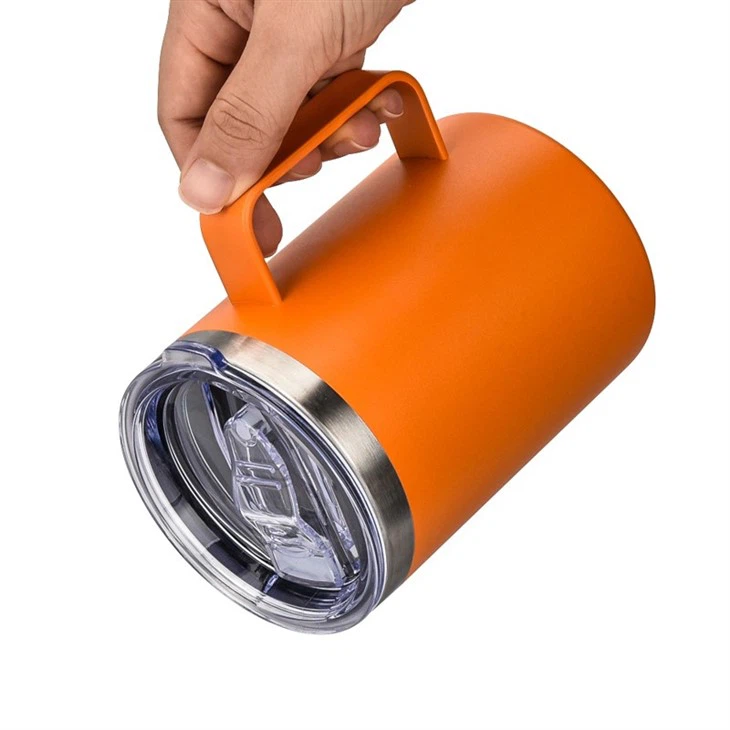
For instance, in a series of tests conducted in an environment with an outside temperature of - 10°C, our Stainless Steel Coffee Mug Cup was able to maintain the temperature of freshly brewed coffee at over 60°C for more than 3 hours. This is a remarkable performance, considering the harsh conditions.
The handle design of our mugs also contributes to heat retention. A well - insulated handle, like the one on our Travel Coffee Mug With Handle, reduces heat conduction from the hot body of the mug to your hand, preventing additional heat loss.
Factors Affecting Heat Retention
While stainless steel vacuum coffee mugs generally have good heat - retention properties in cold weather, several factors can influence their performance.
The initial temperature of the liquid is important. A hotter beverage will take longer to cool down. If you pre - heat your mug with hot water before pouring in your coffee or tea, it can help maintain a higher temperature for a longer period.
The frequency of opening the mug also matters. Every time you open the lid, you allow hot air to escape and cold air to enter, which speeds up heat loss. Therefore, it's best to minimize the number of times you open the mug in cold weather.
The quality of the vacuum seal is another crucial factor. A well - sealed mug will have better heat - retention capabilities. Our Stainless Steel High Vacuum Mug is carefully manufactured to ensure a tight vacuum seal, which is essential for long - lasting heat retention.
Comparison with Other Types of Mugs
When compared to other types of mugs, such as ceramic or plastic mugs, stainless steel vacuum coffee mugs have a clear advantage in cold weather. Ceramic mugs are good at holding heat initially, but they conduct heat relatively quickly, so the beverage inside cools down faster in cold conditions. Plastic mugs are even worse in terms of heat retention as plastic is a better conductor of heat than stainless steel.
Stainless steel vacuum coffee mugs also offer durability and portability. They are resistant to breakage, making them ideal for outdoor use. Whether you're skiing, hiking, or simply walking to work on a cold day, our mugs can keep your drink hot and fresh.
Conclusion
In conclusion, stainless steel vacuum coffee mugs do have excellent heat - retention properties in cold weather. Thanks to their double - walled vacuum insulation design, they can effectively reduce heat transfer through conduction, convection, and radiation. Our mugs are built to withstand extreme cold temperatures and keep your beverages hot for hours.
If you're in the market for a high - quality stainless steel vacuum coffee mug that can perform well in cold weather, look no further. We offer a wide range of mugs to suit your needs, from stylish travel mugs to classic coffee cups.
We invite you to reach out to us for procurement discussions. Whether you're a retailer looking to stock our products or an individual interested in bulk purchasing, we're ready to offer you the best deals and excellent customer service.
References
- Principles of Heat Transfer by Frank Kreith and Raj M. Manglik
- Handbook of Thermal Engineering edited by D. Yogi Goswami and F. Kreith